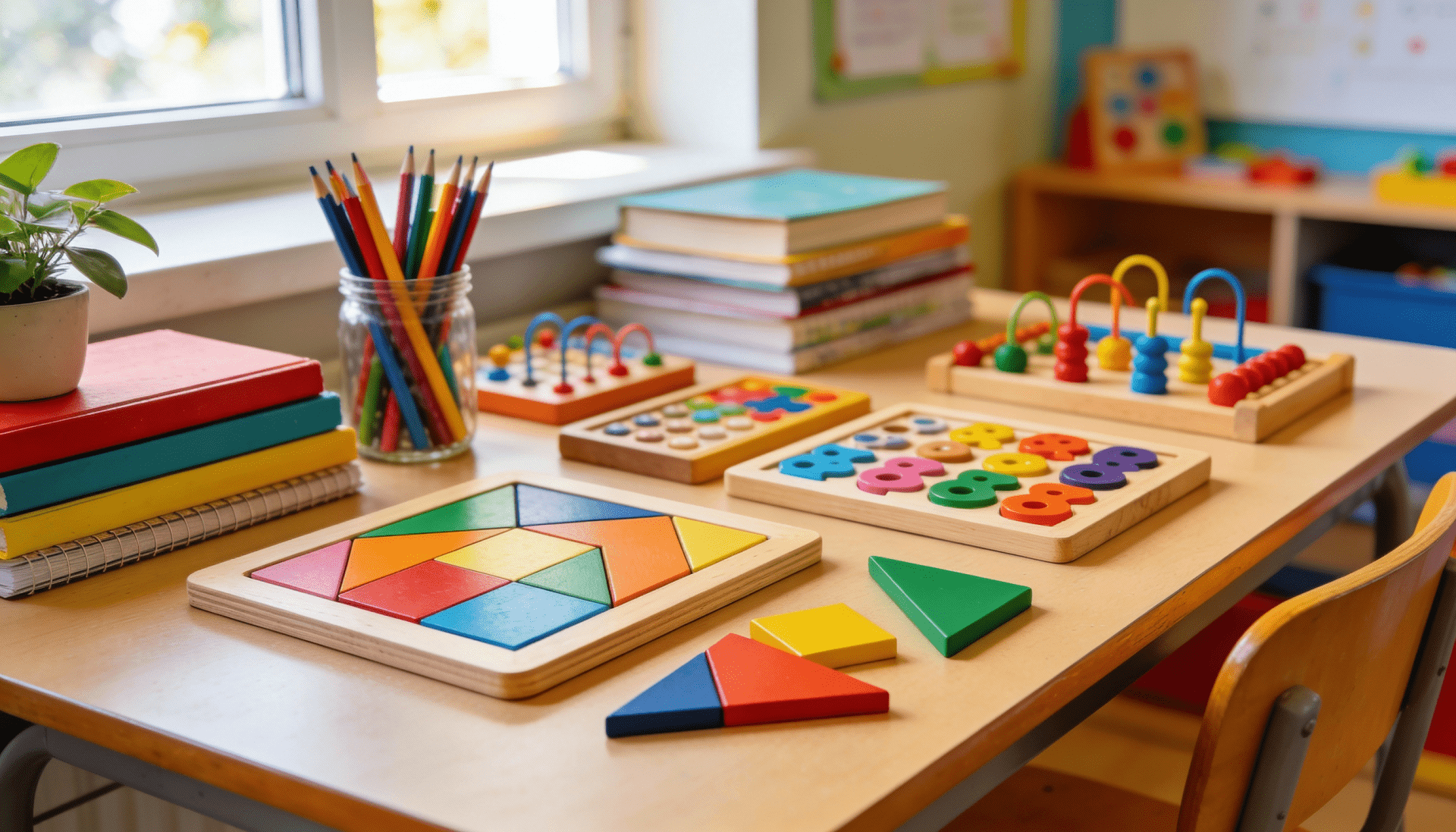
There is a scene that repeats itself in classrooms around the world: a student struggling to keep their eyes open during a theoretical lesson suddenly transforms when the teacher brings out a puzzle or logic game. Eyes light up, posture changes, and that same student who seemed lost a moment ago now leads their group with contagious enthusiasm.
The power of playful learning
The most innovative educators have discovered what children always knew: learning is natural when it disguises itself as play. Puzzles, in particular, have become invaluable allies in subjects that go far beyond mathematics.
Applications by subject
- History: Students reconstruct maps of ancient empires, visualizing the territorial expansion of Rome or medieval trade routes
- Biology: They assemble systems of the human body piece by piece, learning anatomy in a memorable way
- Art: They explore fragmented masterpieces that reveal their genius when completed
- Geography: They learn countries, capitals, and geographical features while playing
- Languages: Puzzles with vocabulary reinforce learning of new words
Error as teacher
What makes puzzles special in the educational context is the nature of error. When a piece doesn't fit, there is no negative grade, no judgment, only information. The student simply tries again, developing resilience and persistence without the emotional weight of traditional failure.
This freedom to make mistakes without consequences creates an environment where experimentation flourishes. Students:
- Dare to try creative solutions
- Learn that error is part of the process, not its end
- Develop frustration tolerance gradually
- Celebrate small achievements along the way to the goal
Natural teamwork
The teamwork that naturally arises around a puzzle is another educational gift. Students learn to communicate, divide tasks, and value the different strengths of each classmate.
Positive group dynamics
We observe fascinating patterns when students work together on puzzles:
- The student who excels at pattern recognition works alongside the one with an eye for colors
- The more methodical ones sort pieces while the intuitive ones look for connections
- Natural leaders emerge organizing the group
- The more introverted find their space to contribute without pressure
An organic collaboration is created where everyone shines, preparing students for the teamwork they will encounter in their professional lives.
Spatial skills for the future
The spatial and visualization skills that puzzles develop have applications that transcend the classroom. Future architects, engineers, designers, and artists build their foundations while they play.
The ability to imagine how pieces fit together, to mentally rotate shapes and anticipate results, is training that will serve for a lifetime. Studies show that:
- Children who solve puzzles regularly show better performance in mathematics and science
- Developed spatial skills predict success in STEM careers
- Mental visualization improves understanding of abstract concepts
Puzzles in the digital age
Custom digital puzzles offer additional advantages in the educational context:
- No lost pieces: a classic classroom problem solved
- Adjustable difficulty: each student can work at their level
- Customizable content: teachers can create puzzles with specific didactic material
- Progress tracking: metrics that help evaluate development
- Accessibility: any device becomes a puzzle table
A revolutionary tool that doesn't need batteries
In a world where education constantly seeks to reinvent itself, puzzles represent something beautiful: an ancestral tool that remains revolutionary. They don't need batteries, they don't require an internet connection (although the digital version does), and yet they achieve something that the most advanced technology often cannot: making students want to keep learning when the bell rings.
Implement puzzles in your classroom or at home
If you're an educator or parent, creating custom puzzles with educational content is easier than ever. You can transform any didactic image into an interactive game that reinforces learning.
Also discover how puzzles benefit memory and concentration, fundamental skills for any student. And if you're looking for historical inspiration, learn how puzzles were born precisely as an educational tool more than 260 years ago.
Start creating educational puzzles and transform the way your students or children learn.