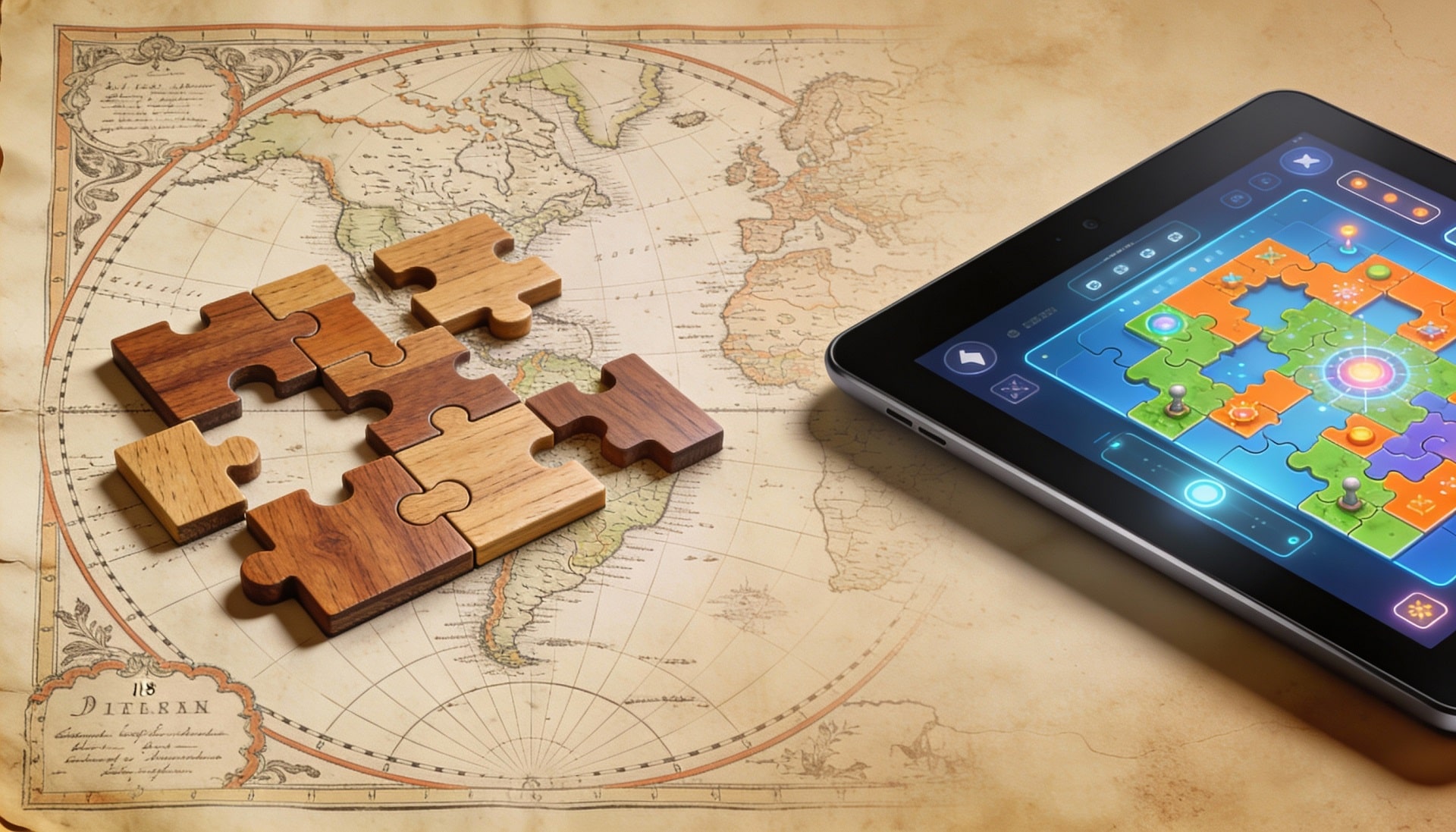
The year is 1760 in London, and a cartographer named John Spilsbury has an idea that would forever change the way we learn and have fun. With delicacy, he glues a map onto a thin wooden board and, using a marquetry saw, cuts out each country following its natural borders. He has just created the first puzzle in history, though he called it a "dissected map."
The origins: education for the aristocracy
Spilsbury's intention was noble and practical: to teach geography to the children of British aristocracy in a way that did not exist before. The little ones learned the shapes of countries while their hands searched for how to fit them together, turning study into play and play into learning.
His invention was a resounding success among wealthy families of the era. The "dissected maps" became the perfect gift for the children of nobles and bourgeois, combining entertainment with instruction in a revolutionary way.
The first puzzles: unique works of art
For more than a century, puzzles remained a luxury reserved for a few. Each piece was cut by hand, a laborious process that made even a simple puzzle cost what a worker earned in several weeks.
These first puzzles were true works of art:
- Noble materials: mahogany, cedar, or oak wood
- Handcrafted cutting: each piece was unique and unrepeatable
- Hand-painted images: detailed maps with vibrant colors
- Decorated boxes: the packaging was as important as the content
They were collector's items, status symbols, family treasures passed down from generation to generation.
The industrial revolution: puzzles for everyone
The revolution came with industrialization. By the late 19th century, die-cutting presses and pressed cardboard democratized puzzles. Suddenly, any family could afford one.
Images diversified: no longer just maps, but:
- Idyllic landscapes of mountains and lakes
- Artworks by the great masters
- Everyday scenes of Victorian life
- Illustrations from popular tales
Puzzles became the quintessential family entertainment, especially during long winters when families gathered around the table.
The golden age: puzzles during the Great Depression
The Great Depression of the 1930s brought, paradoxically, the golden age of the puzzle. Millions of families without resources for other entertainment found hours of affordable fun in them.
They were sold in "dime stores", exchanged between neighbors, became social events. Manufacturers produced millions of units weekly to satisfy an insatiable demand.
Curious facts from this era
During the 1930s:
- More than 10 million puzzles per week were sold in the United States alone
- Public libraries lent puzzles as if they were books
- The first "puzzle clubs" emerged where enthusiasts shared and competed
- Some companies used puzzles as marketing tools, giving them away with their products
The leap to the digital world
And now, in the 21st century, puzzles have taken a leap that Spilsbury never could have imagined. The screens of our devices have become infinite tables where we can solve puzzles of any image, at any time, sharing the experience with people on the other side of the world.
Custom online puzzles represent the natural evolution of this centuries-old tradition. Now we can:
- Create puzzles with our own photos: special moments turned into games
- Choose the difficulty: from 25 to hundreds of pieces
- Play from anywhere: computer, tablet, or mobile
- Share with friends and family: regardless of distance
- Compete for the best time: global rankings for the most competitive
The essence remains intact: that unique satisfaction of finding where each piece fits. Only the tools have changed.
The future of puzzles
What does the future hold? With virtual and augmented reality advancing by leaps and bounds, we might soon be solving three-dimensional puzzles floating around us, or perhaps collaborative puzzles where people from different continents work together in real time.
What's certain is that, more than 260 years after Spilsbury cut his first map, puzzles continue to capture the imagination of millions of people. And you can be part of this story: create your first custom puzzle and join a tradition that has crossed centuries.
Want to know more about the world of puzzles? Discover the incredible benefits puzzles have for your memory or explore curiosities about the most difficult puzzles in the world.